
Christine Schulz is a strategist and founder focused on culture, technology, and consumer behavior. Her work explores the intersection of narrative, systems, and emerging media.
My background in the arts was never just about painting. It was always about understanding how people think, feel, and relate to an ever-changing world. That lens allows me to pick up on cultural inflection points early and understand the mental and emotional frame of a consumer or market segment—meeting people where they are and communicating ideas in a way that actually resonates.
I believe art is not what you do, but how you do it. The best work—across any domain—shares three qualities: intentionality, coherence, and discipline. It isn’t ego-driven; it’s about the audience, the ideas being explored, and what the work itself requires.
This portfolio documents that thinking in practice through a brand I built from scratch in the media and streaming space, the writing I do independently, and the strategic frameworks I developed without a team or playbook.
Streevo
Preface
The work in this portfolio comes from one primary source: Streevo, a consumer tech concept I co-founded in 2025 around streaming media ownership. I built the brand, wrote all the copy, developed the content strategy, and did the market research independently, without a team or agency. Streevo addresses a fundamentally media problem. Streaming fragmentation, rising costs, disappearing content, shifting platform behavior — these are the forces reshaping how consumers relate to media right now. Understanding them well enough to build a brand around them required the same research-to-strategy thinking that drives effective media planning.
The concept grew out of my father’s A/V startup, Modulus Media Systems — an all-in-one home media server sold B2B at a luxury price point. I wanted to build a consumer version: something I or my friends could actually afford. When the TikTok ban surfaced a broader shift in sentiment around digital ownership, the opportunity became clear.
Streevo strips the Modulus down to its core patented IP, and repackages it for the streaming era. The name is a mashup of “streaming” and “TiVo.” The product is exactly what that implies.
Constraints
-
No comparable product existed in market, so positioning had to be built from scratch, with no shorthand to borrow from
Dual audience problem: investor logic and consumer emotion required different language for the same product
Shifting a culturally ingrained preference rather than simply describing a product consumers already know they want
-
No budget for formal research, all insight drawn from behavioral trends, public data, and community listening
No team, no agency. Every strategic, creative, and written output produced independently
Building desire for a product not yet physically available to consumers
-
Communicating a technically complex product in emotionally simple consumer language
Establishing credibility and trust for a first-time brand in a space dominated by trillion-dollar companies
Streevo — Brand Identity
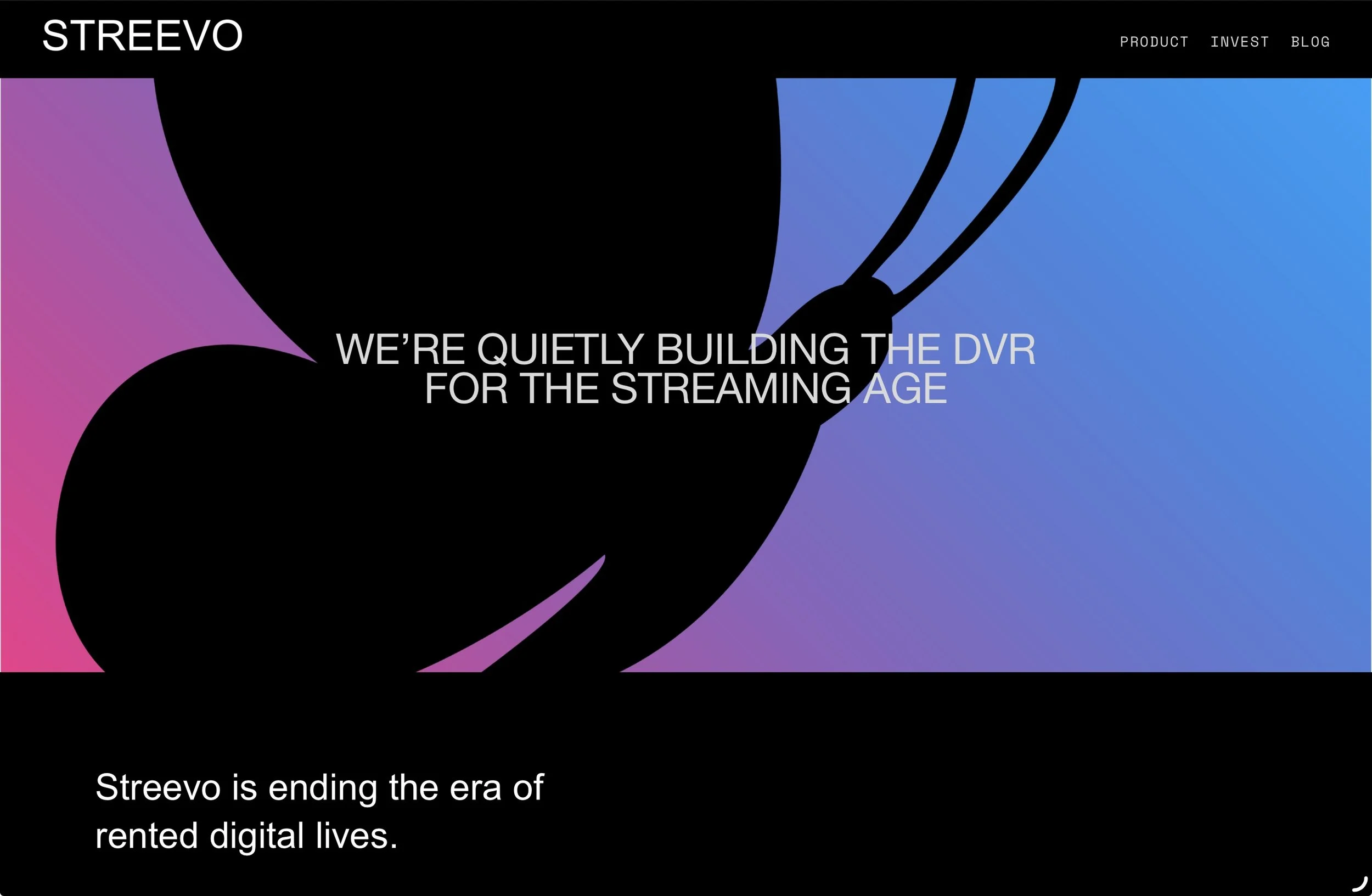
Streevo’s brand colors are inspired by consumer-facing media brands popular with young people like Instagram and TikTok. The high-intensity pink and blue add energy, fun and excitement to the crisp, bold minimalism of black and white.
streevomedia.com — I wrote and designed the full website. The homepage headline (“We’re quietly building the DVR for the streaming age”) and subheadline (“Streevo is ending the era of rented digital lives”) were developed through the same process a media strategist uses: identify the consumer’s emotional pain point, then find the sharpest possible language for it.

The Logo
I chose a butterlfy for its layered meaning: transformation, lightness, and emergence. The butterfly doesn’t rebel against the caterpillar—it incorporates and transcends it, leaving behind restriction and growing wings. Shown in flight rather than statis, it suggests movement and an optimistic path the consumer is invited to follow.
Streevo integrates the streaming model without rejecting it, adding an ownership layer on top, and offering freedom with the same ease that streaming once promised.
Market & Consumer Pain Landscape
Before developing any messaging, I mapped the consumer pain landscape—identifying not just the logistical frustrations but the emotional undercurrent driving behavior change. This is the research that informed every positioning and channel decision.
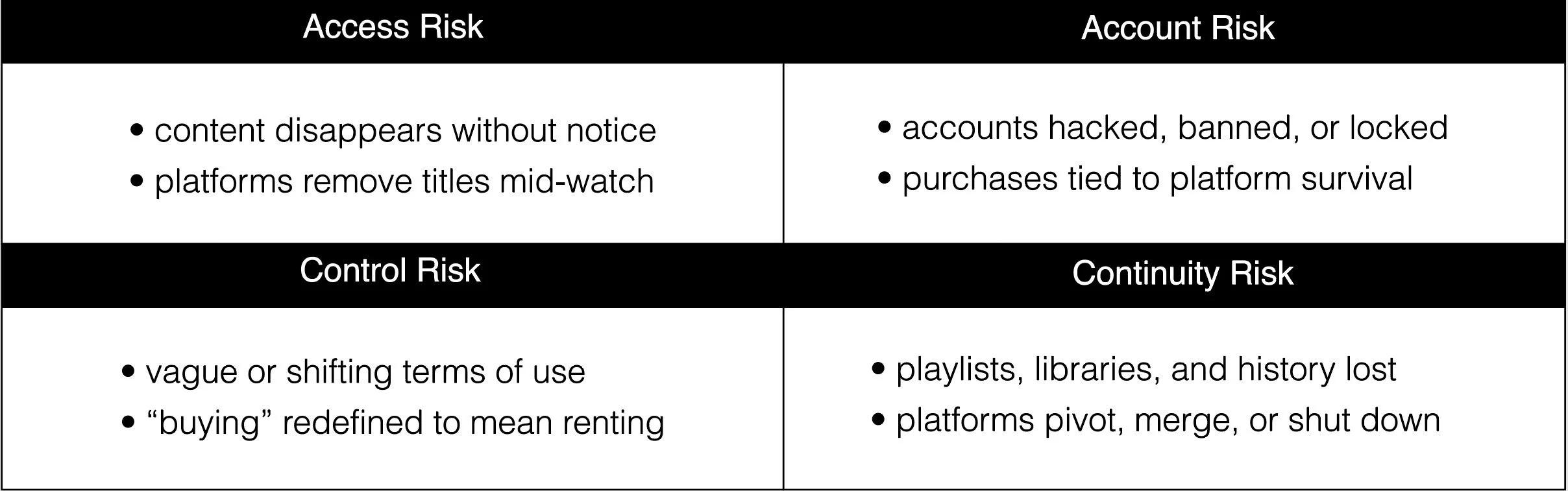
Key Data Points from Research
$924/year
Average American spends on media subscriptions annually—for content they don’t keep
75%
of Gen-Z pirates content while subscribed to platforms
41%
Growing hybrid audience utilizing physical media while subscribed to streaming platforms
115+M
U.S. streaming households managing an average of 4-6 platforms simultaneously
Channel Strategy & Audience Targeting
To determine Streevo’s Go-to-Market strategy, I identified target audience segments, mapped their emotional drivers, and selected the media channels most likely to reach them efficiently. This required synthesizing behavioral research, platform data, and consumer insight—the same inputs that drive a media strategy recommendation.
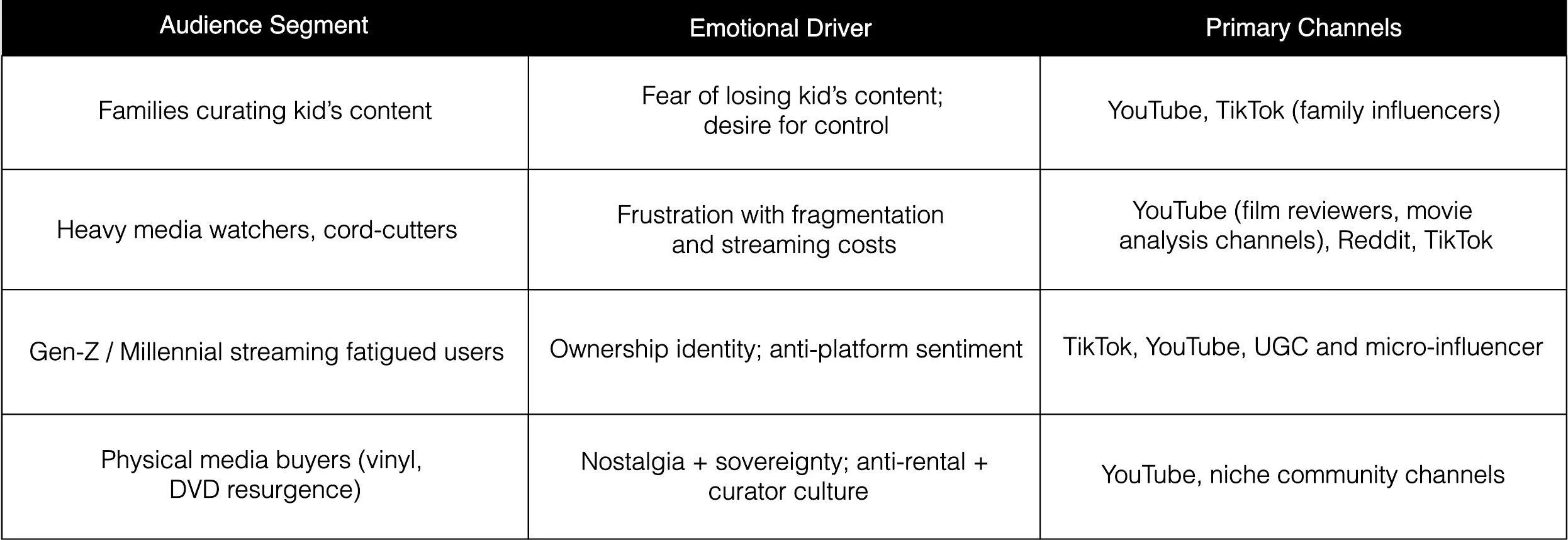
Entering a market dominated by trillion-dollar platforms, trust is the primary obstacle. Influencer partnerships solve for this directly—young consumers place more faith in personalities they follow than in big tech brands. It positions Streevo as a bottom-up player in an emerging movement rather than another device company asking for attention it hasn’t earned.
Creative Approach:
emotionally-driven campaigns built around the ownership narrative, amplified through paid digital (Meta, YouTube, TikTok) and influencer partnerships with family creators, film reviewers, and aligned media personalities.
Streevo doesn’t rely on virality. It engineers it.
Website Copy — Consumer Messaging
Streevo’s website presented an interesting challenge because it needed to present the concept in a manner that would be legible to consumers in order to attract waitlist sign-ups and pre-production traction, but also sell the opportunity to potential investors.
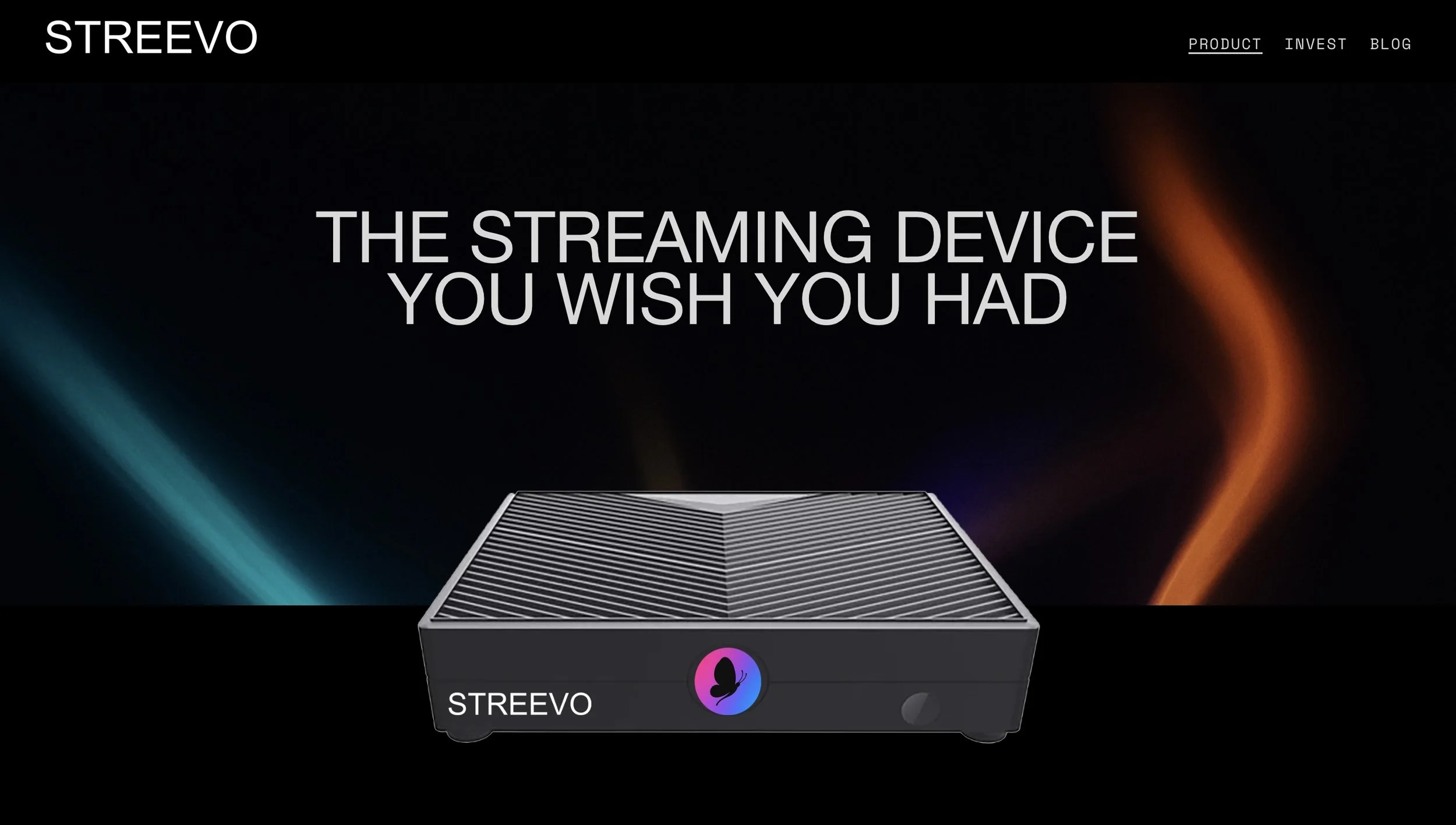
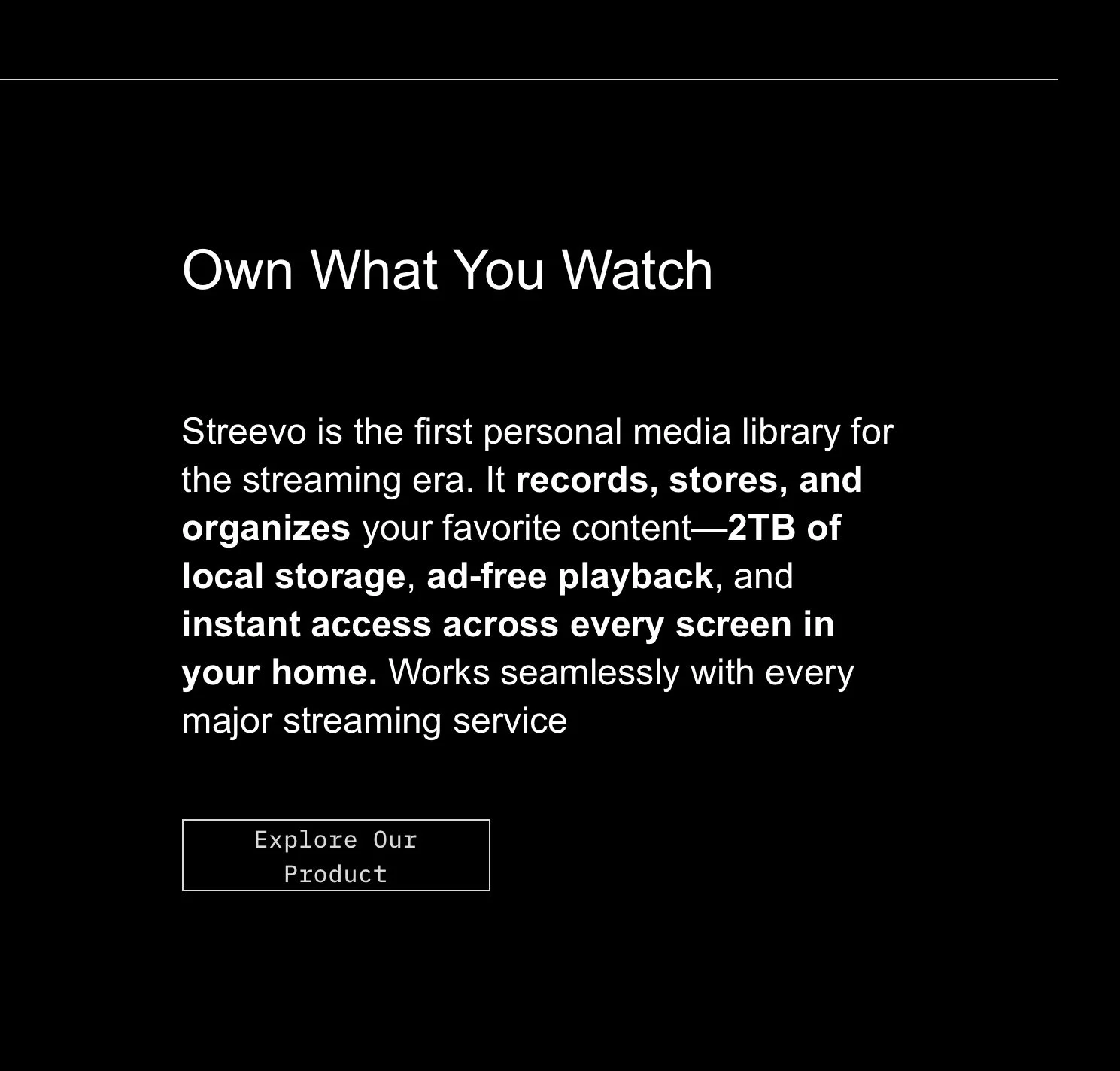
Consumer messaging for a technical product has one job: answer “what does it do for me?” quickly and simply, without requiring the user to understand how it works.
“Own What You Watch” distills a complex value proposition into four words. Every choice was deliberate: “records, stores, and organizes” addresses functional anxiety; “instant access across every screen” mirrors the convenience language streaming users already know.
Website Copy — Investor Messaging
Investors are equally uninterested in technical specs. Their priority is in understanding the legitimacy of the core IP, its failure to success odds, and the potential for upside.
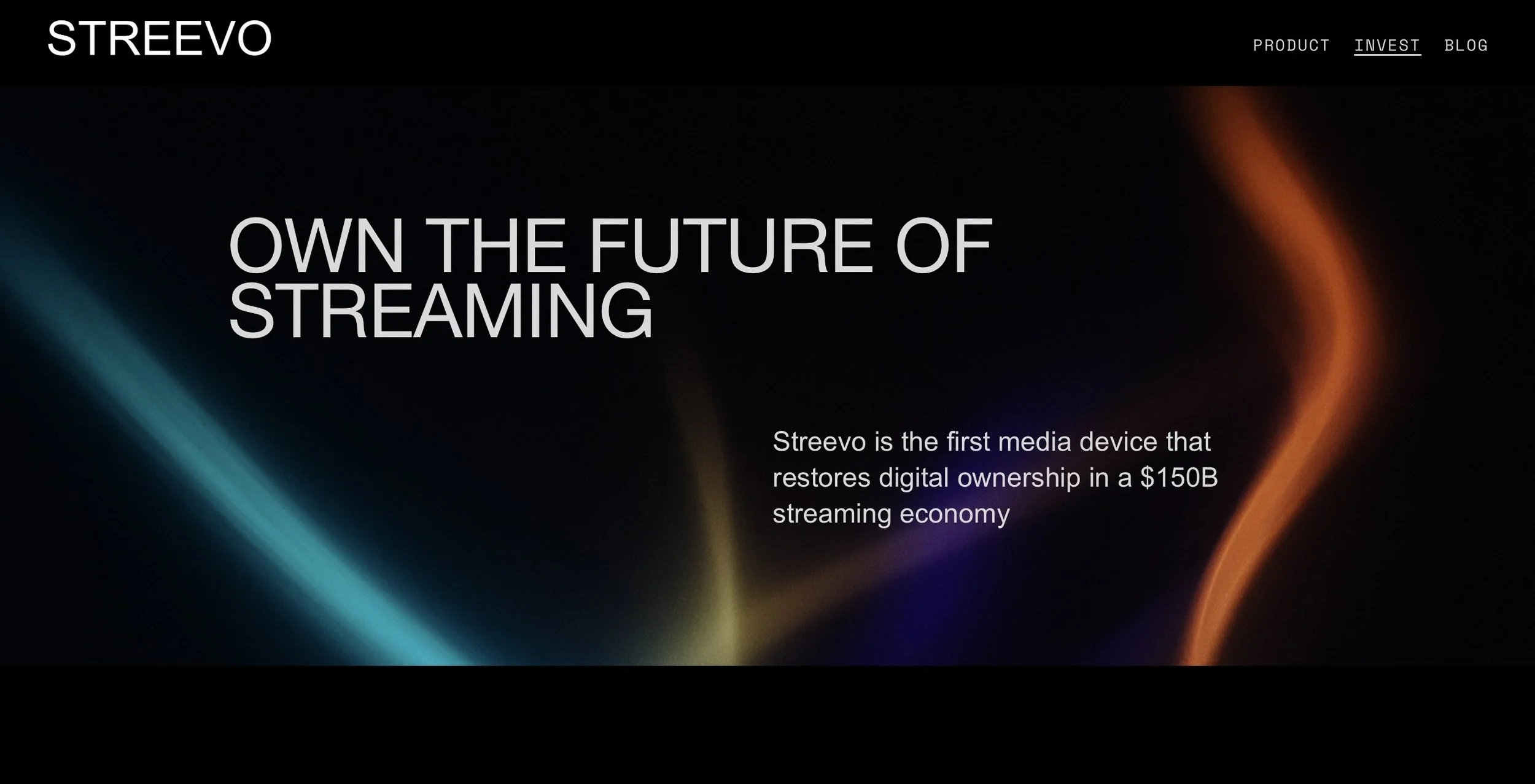
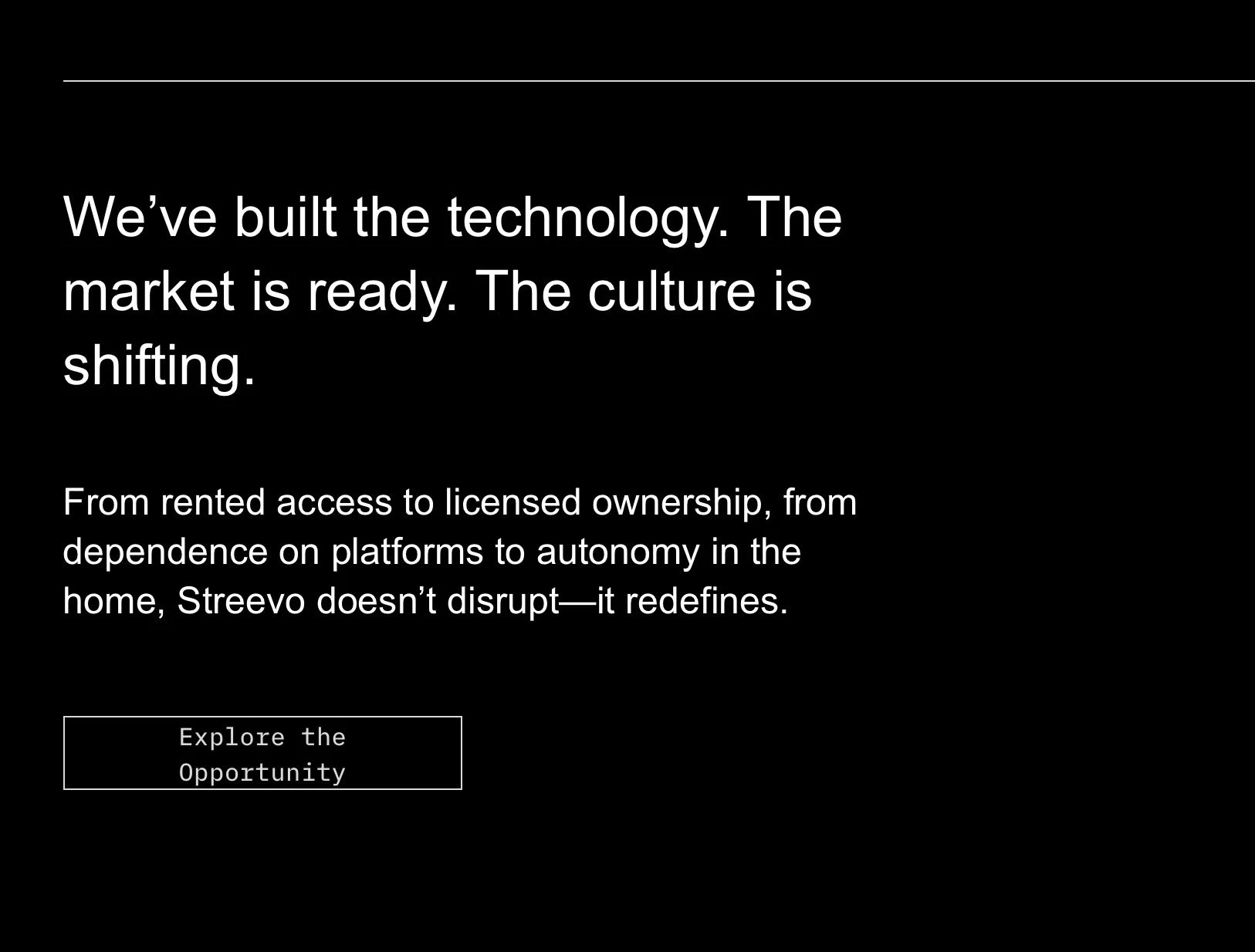
There was real temptation to lean into a counter-cultural, disruptor identity—but investors are wary startups that position themselves as revolutionaries. It raises questions about incumbent pushback and regulatory risk.
“Own the Future of Streaming” threads the needle: it unites the consumer and investor value propositions under the same theme—ownership—while framing Streevo as an evolution of the media landscape, not a disruption of it.
Content Strategy — Editorial & Blog
I developed a content strategy for Streevo’s blog that treated each post as both brand-building and audience research—understanding what angles resonated, what language the audience used, and what questions were driving people to search. Each piece was conceived as editorial content, not marketing copy: the goal was to demonstrate that Streevo understood the consumer’s world better than anyone else.
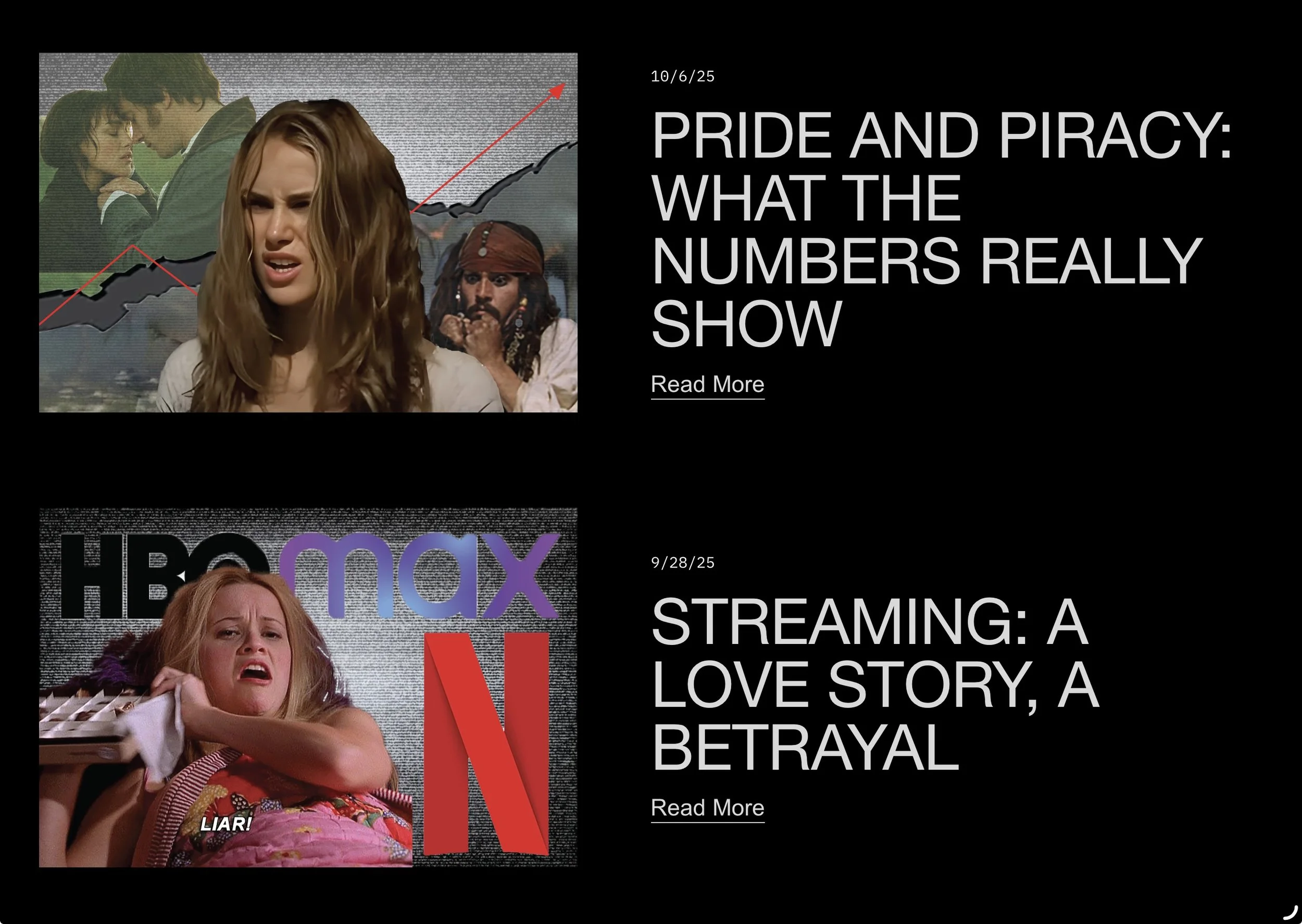
Blog Titles and Creative Direction:
Each post uses a film still as visual shorthand for an emotional state, playing off of the content that users care about.
The content and visuals for each blog was intended to be easily convertible into other formats, like YouTube videos, that consumers might actually enjoy watching and following.
The creative approach was deliberate: meet the audience in the cultural language they already speak.
Consumers of online content don’t click on what they perceive to be ads, they click on what is useful to them, what they think they can learn from, and what aligns with their interests. Because consumers are unlikely to search for a category of product that doesn’t exist yet, Streevo’s content strategy needed to educate, inform, and generate demand through authenticity and an implicit message: streaming is broken, and Streevo is here to fix it.
Writing Samples — Independent Publishing
I write independently about media, technology, and consumer behavior. The following is excerpted from “Give Me Sovereignty,” published on Substack. It demonstrates how I think about inflection points in media—the kind of structural analysis that underlies effective audience and channel strategy.
“The word of 1776 was ‘liberty.’ The word of 2026 is ‘slop.’ The word of 2030 will be ‘sovereignty.’”
On identifying inflection points —
”Big trends don’t move linearly.. They turn. You can identify an inflection point when something that used to work begins breaking, when behavior shifts (even subtly), and when second-order effects start appearing. The best opportunities are right as the shift becomes visible, but before it’s obvious.”
On the TikTok ban and consumer psychology —
“The anxiety stemmed, not from a love for the TikTok platform specifically, but from a lack of control. This brings us to the inflection point: we are entering a new era where people will no longer tolerate not owning their digital lives.”
On piracy as a signal —
“Now 75% of Gen-Z admits to using video piracy sites while subscribed to major platforms. Open the comments section under any YouTube video bemoaning the loss of ownership and you’ll inevitably see people justifying piracy with an oft-repeated phrase: ‘if buying isn’t owning, then piracy isn’t stealing.’ That isn’t a meme—it’s a rallying cry.”
On AI accelerating the shift —
“As models make it trivial to produce content at scale, platforms will increasingly be flooded with low-effort, algorithmically optimized media. This doesn’t just degrade quality; it intensifies reliance on centralized platforms to filter and surface what matters. In this environment, ownership becomes more valuable, not less.”
What I Learned — and What Surprised Me
The most useful insights didn’t come from research. They came from conversations—and they contradicted what I thought I knew.
I initially framed the ownership problem as a Gen-Z issue. The data supported it. However when I started talking to people outside that frame, parents were the ones who converted. The use case that turned skeptics into believers wasn’t “own your media library” in the abstract. It was “save your kids’ favorite shows so they’re always there” and “are you shaping your kids’ content environment, or is the algorithm?” The emotional driver wasn’t sovereignty. It was security. That reframe didn’t come from a spreadsheet. It came from a conversation at a dinner table.
The second shift came from a panel at SXSW: a filmmaker-turned-AI-platform-founder I spoke with argued that in an age of content abundance, curation is the scarce resource. AI is flooding platforms with content users didn’t ask for and don’t trust. The response isn’t just piracy or physical media, but a desire for intentionally built, user-controlled libraries. Streevo sits directly inside that shift, not just as an ownership product but as a curation tool for the post-algorithm consumer.
The deeper lesson was about process. Without external accountability, it’s easy to stay inside your own thesis too long. The insights that sharpened my thinking most came from friction—skeptics, unexpected audiences, a stranger on a panel. That’s what I’m looking for next: an environment where that friction is structural.
Beyond Streevo
Beyond Streevo, my background includes communications and written content work at the Brendan Fernandes Studio (grant writing, institutional communications, design, creative presentations for an internationally exhibited artist) and client-facing roles at Monique Meloche Gallery (press releases, newsletter redesign, high-net-worth client relations).
Both gave me experience translating a creative vision into language that reaches the right audience—which is, at its core what media strategy does.